
It Can Be Done
Part 2 of an ongoing investigation into ABA Centers of America and the network of companies controlled by Christopher Barnett , Nathaniel Irvine and Ed McDonough.

Part 1 of this series documented the corporate architecture of a network of interconnected behavioral health companies built around Christopher Barnett, a Fort Lauderdale businessman, Nathaniel Irvine, a New Hampshire operator who built a sober living and addiction treatment network starting in 2014, and Edmund McDonough, a third and quieter principal who operates locally in New Hampshire. According to multiple independent sources familiar with the principals, the three men met in rehab sometime before the first of their companies was formed in 2013.
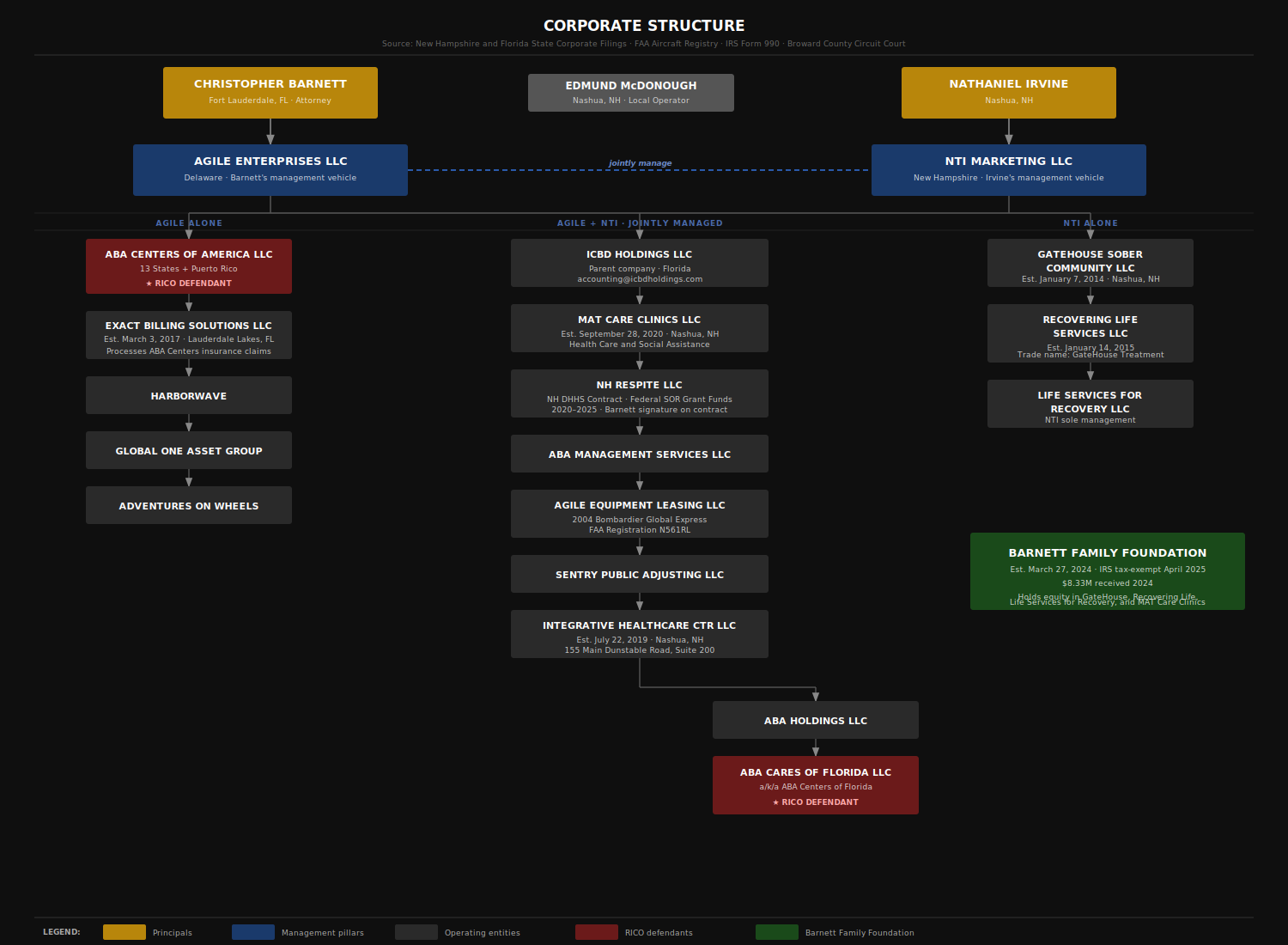
That piece traced the closed-loop billing structure: the same management entities that control ABA Centers of America also control Exact Billing Solutions, the company that submits ABA Centers’ insurance claims. It documented New Hampshire public Medicaid money and federal opioid grant funds flowing into the network. It documented a private jet registered to an entity co-managed by both Barnett and Irvine. It documented the Christopher M. Barnett Family Foundation, formed March 2024, funded December 31, 2024 with $7 million in company interests transferred from inside the network, and granted retroactive IRS tax-exempt status in April 2025. And it documented a $55 million gift to Temple University from the Christopher M. Barnett Family Foundation
Since publication, a second major lawsuit has surfaced and it has been confirmed that the network extends beyond the United States entirely.
This is Part 2. Its subject is money -- specifically, what the people running this network were doing with money while two health insurers were accusing them of fraud.
A Second Insurer Tells the Same Story
The Publix complaint was not the first time a major insurer accused ABA Centers of systematic billing fraud. It was the second.
ABA Centers filed suit against Harvard Pilgrim Health Care and Point32Health Services in Massachusetts Superior Court in both December 2024 and February 2025 claiming, among other things, nonpayment of claims. On October 6, 2025, the Point32Health Subsidiaries (Harvard Pilgrim, Tufts Associated Health Maintenance Organization, and Health Plans, Inc) filed an amended counterclaim targeting ABA Centers and a second network entity, Integrative Healthcare Services, LLC. They described a “calculated and far-reaching scheme” to defraud and manipulate the healthcare reimbursement system, and are seeking more than $19 million in damages. The specific conduct alleged: billing for services not rendered, using billing codes that didn’t accurately represent the services provided, overbilling, billing for medically unnecessary services, double billing, upcoding, and billing the wrong location for services the company knew weren’t covered.
Publix filed its federal RICO complaint in Florida the following October. Two major insurers, in two states, are now telling courts the same story about the same company.
Both cases are currently making their way through the court system.
The Network Goes to Colombia
Since Part 1 published, reporting has also surfaced that the network is international.
Records from Colombia’s RUES national business registry show that a company called ABA Tech S.A.S. was registered June 10, 2022 with the Chamber of Commerce of Medellin. The legal representative recorded in that registry is Christopher Michael Barnett. ABA Tech S.A.S. was registered two years before CurativeAI (the network’s US-based AI healthcare company) was incorporated in July 2024. According to sources familiar with the structure, ABA Tech was the original attempt to build a technology platform supporting the US behavioral health operations. When that entity encountered difficulties, the principals incorporated CurativeAI in the US and subsequently opened a Colombian counterpart called Curatech.
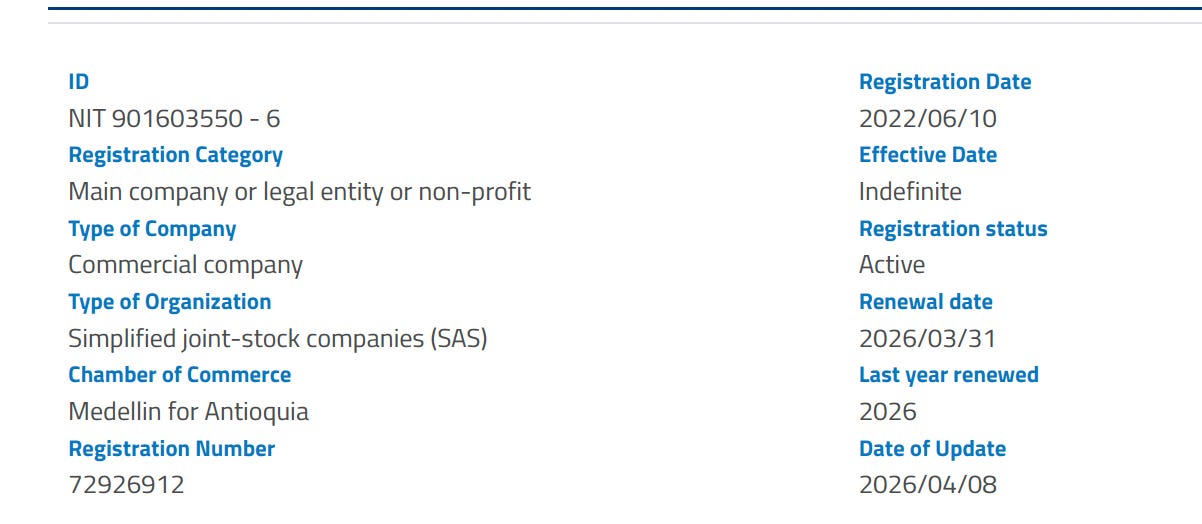
What is documented is that Barnett is the named legal representative of a Medellin company that predates by two years the US entity he has publicly promoted. In the United States, meanwhile, other things were being acquired.
The Vessel and the Condo
In July 2024, a 56-foot HCB Sueños GIX -- base price over $3 million -- was delivered to Fort Lauderdale. The USCG registry shows the vessel named “It Can Be Done,” the same four words that form the acronym of ICBD Holdings. A Fort Lauderdale marine services company subsequently documented the same vessel being hauled out for service, identifying it on TikTok as a “56’ HCB ‘It can be done.’” Five months later, four armed agents would spend nine days guarding it in St. Barthelemy. That bill would never be paid.

On October 6, 2025 -- the same evening Harvard Pilgrim and Point32Health filed their fraud counterclaim in Massachusetts -- Barnett purchased a condominium at 1414 South Penn Square in Philadelphia for $640,000 cash. The deed records no mortgage. Four days later, Temple University announced the $55 million gift.

The CEO Is Also The Company’s Real Estate Broker
While running a company facing fraud allegations from multiple insurers, Barnett was also quietly collecting personal real estate commissions on his own company’s clinic leases.
Court records show that Barnett was licensed as a real estate sales associate (personally, not through ICBD or ABA Centers) and brokered his own company’s clinic leases across at least 37 transactions between 2022 and 2024. Under an Independent Contractor Agreement with Realty Hub, commissions generated by those leases were supposed to flow back to Barnett personally, with Realty Hub keeping only a $100 annual membership fee and $100 per transaction. The commissions on those 37 leases totaled more than a million dollars.
When Realty Hub began withholding Barnett’s share of those commissions, he sued them on December 31, 2024. He dismissed the case himself one day later, on January 1, 2025 -- before any discovery could begin. No one ever had to answer questions under oath about where that money came from or where it went.
The arrangement raises a question that the lawsuit’s swift dismissal left unanswered: when ABA Centers paid real estate commissions on its own clinic leases, and those commissions were contractually owed to the company’s own CEO, who ultimately bore that cost?
What the Security Bills Reveal
On November 11, 2024, as fraud allegations were mounting, ICBD Holdings signed a security services agreement with FocusPoint International.
What FocusPoint was hired to do is documented in eight invoices that ICBD never paid. In January 2025, four armed agents spent nine days in St. Barts guarding Barnett, his family, his staff, and his private vessel in Gustavia. In February, two armed agents and two armed drivers spent eight days at Bachelor’s Gulch, a luxury ski resort in Colorado, departing by private aircraft from Vail. Separate details covered Puerto Rico, Orlando, and Barnett’s Fort Lauderdale home, where armed agents worked rotating twelve-hour shifts at the front and rear of the residence around the clock.
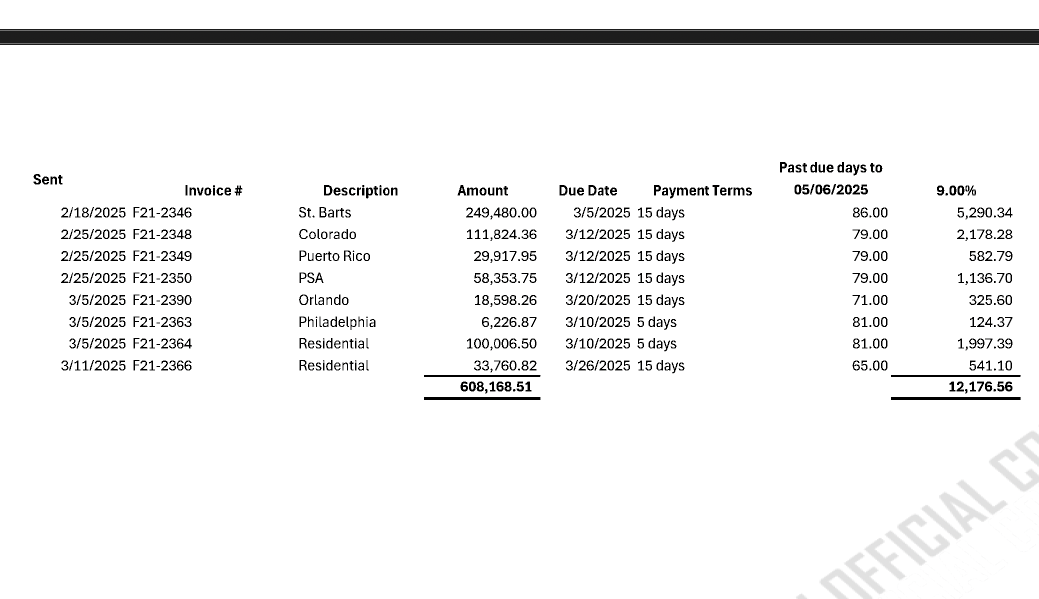
The total bill was $608,168.51. ICBD paid none of it.
FocusPoint sued in May 2025. ICBD did not respond to the complaint or the demand letter, or to any of FocusPoint’s follow-up emails. When FocusPoint moved for a default judgment in July, its own counsel learned through other channels that ICBD had missed the deadline due to a prolonged medical emergency affecting its representative. FocusPoint withdrew the motion. Two months later it dismissed the case with prejudice, a filing that prohibits refiling, and almost certainly reflects a settlement whose terms are not public.
What the invoices leave unanswered is a more basic question: why does the CEO of an autism therapy company need four armed guards on a Caribbean island, around-the-clock armed agents rotating shifts outside his home, and a security detail at a Colorado ski resort? ABA Centers presents itself publicly as a mission-driven healthcare company founded to help children. The security footprint documented in these invoices is not that of a healthcare executive. It is that of someone who believed that he needed to be protected.
The Pattern
FocusPoint was not an isolated case. It’s the illustration of a pattern that runs throughout this network’s financial history: pay nothing until someone files a lawsuit, then make it go away.
In September 2024, ICBD hired a Hollywood, Florida contractor called NCT Corporation to outfit its headquarters with structured cabling and AV equipment. By the following spring, NCT was sending demand letters for more than $132,000 in unpaid invoices. An ICBD accounts payable specialist acknowledged the bills by email and said they were “waiting for approval.” NCT filed suit in October 2025. Partial payments followed. The case closed.
In March 2026, the landlord of an ABA Cares of Florida clinic space in Tamarac, Fl that the company had leased just three months earlier to serve as an autism treatment center -- sued for eviction after ABA Cares failed to pay more than $220,000 in rent and fees. The case was dismissed at the plaintiff’s request in May 2026.
Accurate Employment filed the most recent lawsuit on May 11, 2026, alleging unpaid invoices for staffing services provided to ICBD. The case is open.
Multiple independent sources with direct knowledge of the company’s financial practices described the same pattern. The invoices pile up, the calls go unreturned, and payment arrives only when a complaint is filed.
The Foundation
Against this backdrop - vendors unpaid, two fraud complaints pending, a security firm owed $600,000 for a Caribbean yacht trip - the Christopher M. Barnett Family Foundation was presenting a very different face to the world.
Before examining what the foundation’s IRS filings actually show, it helps to understand what the foundation is. It was formed on March 27, 2024. On December 31, 2024, $7 million in company interests were transferred into it. The IRS granted it retroactive tax-exempt status in April 2025. Its managers are Christopher M. Barnett and Julie Barnett.
Irvine’s companies, Barnett’s foundation.
The interests transferred into the foundation came from four companies: Gatehouse Sober Community, Life Services for Recovery, MAT Care Clinics, and Recovering Life Services. The management picture across those four entities varies: some are managed by Barnett’s company, some by Irvine’s, and at least one by both. But across all four, Nathaniel Irvine is the registered agent, his name and his Nashua address are on every filing.
Nathaniel Irvine is not listed as a manager of the foundation. He has no stated governance role in it. Interests in these companies, valued collectively at $7 million, now sit inside a private foundation controlled entirely by someone else, and there is no public record explaining what Irvine received in exchange or what rights, if any, he retains.
The cash that didn’t add up.
When the foundation opened, it had $35,000 in cash. The $7 million in company interests it received is not liquid -- it cannot be written as a check or used to pay a grant.
The foundation’s 2024 IRS filing reports $816,575 in cash grants paid out during its first year. The filing does not explain where that cash came from, given that the foundation had $35,000 when it opened and its only significant asset couldn’t be spent.
The boat nobody received.
The foundation’s 2024 filing reports donating a boat to Soldiers Angels, a San Antonio military charity, in August 2024. Book value: $405,000. The foundation says it was worth $93,000 at the time of the gift -- a $312,000 gap that is unexplained in the filing.
Soldiers Angels’ own publicly available IRS filings do not reflect receiving a boat from the Barnett Family Foundation. Requests for comment or confirmation of this donation went unanswered by Soldiers Angels.
The grants to organizations that are the same organization.
The foundation’s filing reports grants to the Foundation for the Advancement of Autistic Persons and to Eden II School for Autistic Children as though they are separate recipients. They are not. Eden II is a DBA of The Foundation for the Advancement of Autistic Persons operating under a formal support services agreement with shared leadership.
Barnett was appointed to the Eden II board on February 1, 2024. Seven weeks later, he formed his private foundation. By the end of 2024, that foundation was reporting hundreds of thousands of dollars in grants to an organization on whose board he sits.
IRS rules prohibit self-dealing between a private foundation and organizations controlled by its managers. Whether Barnett’s board membership at a recipient organization creates a prohibited transaction is a question for the IRS, not this investigation. The Foundation for the Advancement of Autistic Persons’ 2024 filing is not yet available -- the return that would show whether the grants the Barnett foundation reported making actually appear in their own books. When it is filed, this series will report what it shows.
The $55 million that isn’t there.
On October 10, 2025, Temple University announced that Christopher Barnett had donated $55 million -- the largest gift in the university’s history. The Christopher M. Barnett College of Public Health now bears his name.
The foundation’s 2024 IRS filing shows total assets at year-end of just over $7 million, almost entirely the illiquid company interests that cannot be written as a check. The $55 million gift would appear on the 2025 return, which the foundation is not required to file until November 2026. Until then there is no public document showing where $55 million is coming from, through what vehicle the gift is structured, or whether the foundation described by Temple as its source has or will have the assets to fund it.
What Was Accumulating
In sequence, the timeline of this period looks like this:
February 2024: Barnett is appointed to the Board of Eden II
March 2024: The Christopher M. Barnett Family Foundation is opened.
July 2024: A 56-foot HCB Sueños GIX with a base price over $3 million, and named “It Can Be Done,” is delivered to Fort Lauderdale.
November 2024: A 2004 Bombardier Global Express jet is registered to Agile Equipment Leasing LLC, co-managed by Barnett and Irvine.
December 31, 2024: $7 million in company interests are transferred into the Barnett Family Foundation. The same day, ABA Cares of Florida signs a new clinic lease it will stop paying within weeks and they file a lawsuit against Pilgrim Health for non-payment.
January 2025: Four armed agents guard the vessel and its owner’s family in St. Barthelemy for nine days. The bill will never be paid.
February 2025: ABA Centers files a second lawsuit against Harvard Pilgrim/Point 32 claiming non-payment.
April 2025: ABA Centers Named No. 1 on the Financial Times “Americas’ Fastest-Growing Companies 2025” List with an “An Absolute Growth Rate of 33,511.5%”
May 2025: FocusPoint international files lawsuit against ICBD
August 2025: ABA Centers sues Publix Supermarket
October 3, 2025: NCT Corp files a lawsuit against ICBD
October 6, 2025: Barnett purchases a condominium at 1414 South Penn Square in Philadelphia for $640,000 cash. No mortgage. On the same day the Harvard Pilgrim/Point 32 filed a counter claim alleging “a calculated and far-reaching scheme to defraud and manipulate the healthcare reimbursement system”.
October 10, 2025: $55 million Temple gift is announced.
October 23, 2025: Publix files its RICO complaint, later consolidated with ABA Centers’ suit,
November 17, 2025: The foundation files its 2024 return that includes the claim of a donated boat, and other irregularities.
November 18, 2025: Barnett is named the “Entrepreneur of The Year® 2024 National Overall Award winner.”
March 2026: Misala LLC files a lawsuit against ABA Cares of Florida
May 2026: Accurate Employment files a lawsuit against ICBD.
A vessel. A jet. A foundation. A cash real estate purchase made while a federal RICO case was pending. A $55 million university gift whose funding source won't appear in any public document until November 2026 at the earliest. All of it accumulated while the same company was refusing to pay its security firm, its technology contractor, its staffing agency, and its landlord.
What Comes Next
Part 3 will examine what families and clinical staff describe happening inside ABA Centers -- the billing practices, the pressure on clinicians, the relationship between how the company approaches diagnosis and how it approaches enrollment, the HIPAA questions raised by patient data being used to train a commercial AI system, and the families receiving bills for thousands of dollars that their insurers have refused to cover.
Part 4 will examine what the network’s employees are experiencing. The lede is a retirement plan covering more than 1,600 workers that filed its 2024 federal disclosure without the required independent auditor’s report, promising an amendment that a Freedom of Information Act request to the Department of Labor is still seeking to verify.
Part 5 will close the open loops: whether the $55 million Temple gift appears in the foundation’s 2025 IRS filing when it is due in November 2026; whether the grants the Barnett foundation reported sending to Eden II and its DBA appear in that organization’s own books; whether the Soldiers Angels vessel donation shows up where the foundation says it went; and whether any of the agencies that received tips and comment requests before Parts 1 and 2 published have responded.
Part 2 was reported using federal and state court filings, IRS Form 990 and 990-PF filings obtained through ProPublica’s Nonprofit Explorer, USCG vessel registry records, Florida and New Hampshire state corporate filings, Colombian national business registry records, Philadelphia County deed records, FAA aircraft registry data, and interviews with independent sources with direct knowledge of the network. A comment request was submitted to ICBD Holdings’ Chief Legal Officer on May 17, 2026 covering all material in this piece. No response was received before publication.
If you have direct knowledge of ABA Centers of America, ICBD Holdings, or any of the affiliated entities described in this series, contact the author at ABAInvestigations@proton.me
Your examination is completely bias and motivated by unsatisfied employees and misinformation. As a current employee at this company who has admittedly been a part of very terrible companies who lack any ethical supervision guidelines and who have much higher turnover rates (effecting families and colleagues) I attest there are many employees who are happy working for ABA centers.